

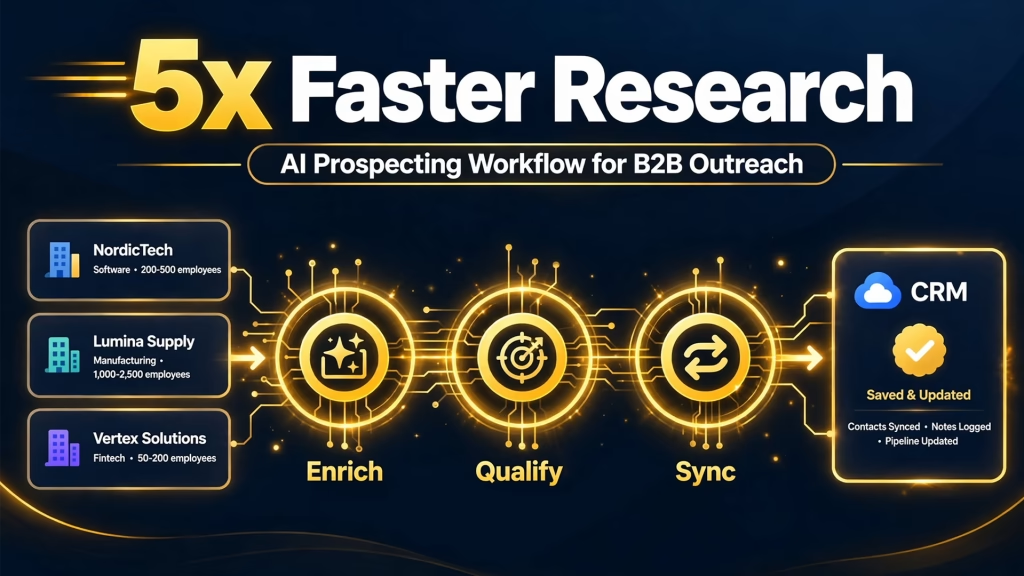
TL;DR: Manual prospect research was slowing a B2B sales team down. I built an AI prospecting workflow for B2B outreach that enriches every lead in Clay, qualifies it against a clear rubric using Claude, and syncs the result to the CRM automatically. Research time per prospect fell from about 15 minutes to 3, data completeness rose to 87%, and the team can now process five times as many accounts without adding headcount.
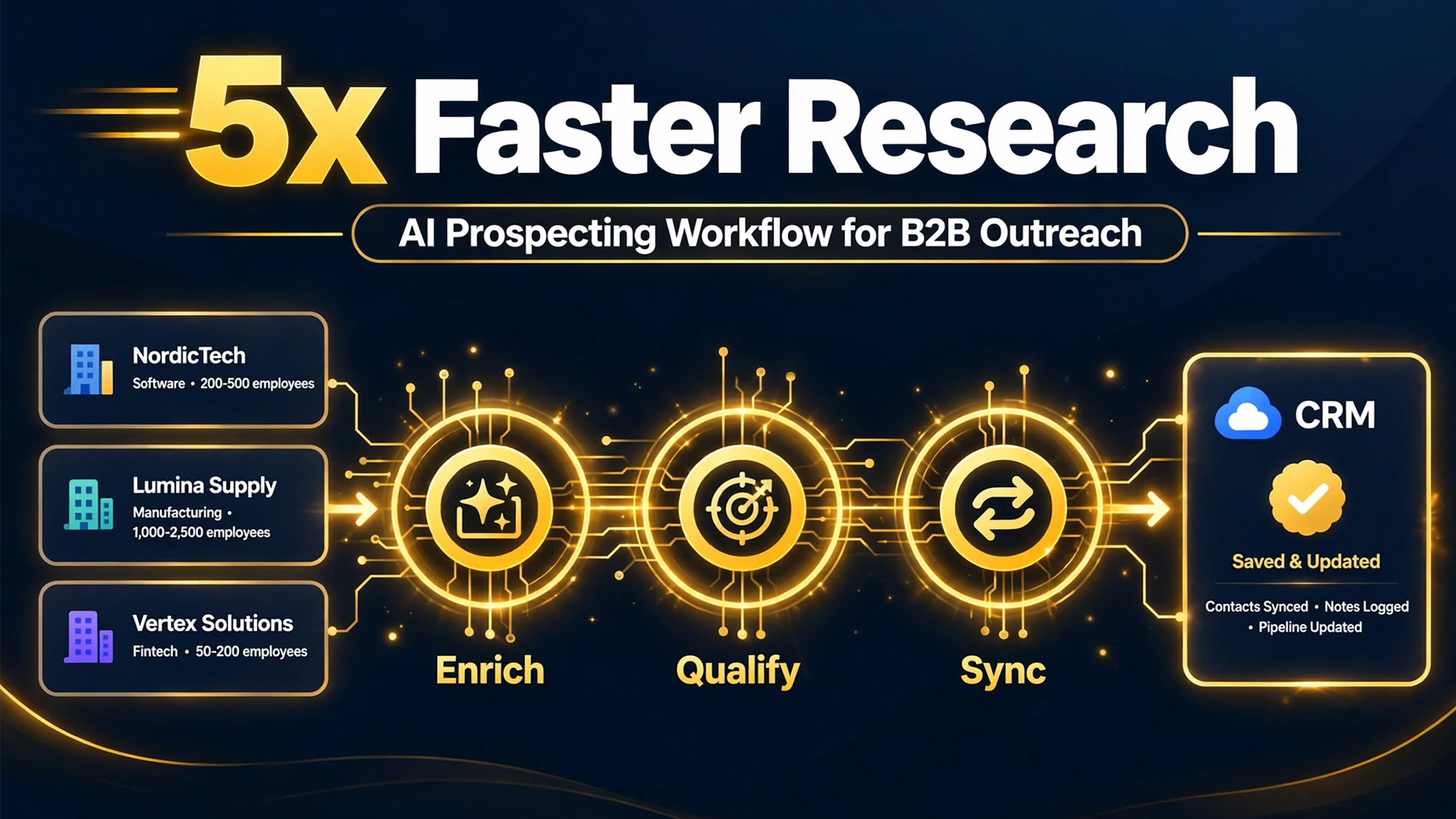
An AI prospecting workflow for B2B outreach is an automated system that finds, enriches, and qualifies target accounts so reps only spend time on the best fits. In this case study, I explain the business problem, how I built the workflow, and how a similar setup could scale your outbound operations.
Project snapshot
| Industry | B2B sales and outbound |
| My role | Sole consultant: strategy, workflow design, prompt and rubric design, integration, testing, handover |
| Timeline | 4 weeks |
| Stack | Clay, Claude, CRM APIs, automation (webhooks and scheduled syncs) |
| Deliverables | Lead enrichment workflow, qualification logic, CRM synchronization |
| Designed outcome | Smarter targeting, faster qualification, and scalable outbound operations |
The business problem: manual prospect research slowed sales outreach
Reps spent more time researching than selling. The pain showed up in four ways:
- Research took about 15 minutes per prospect. Reps opened company sites, LinkedIn, news, and tech lookups for every account, and each rep could only handle around 120 prospects a week.
- Targeting was subjective. Two reps looking at the same account often reached different conclusions about whether it was a good fit.
- Data was incomplete and messy. Only about 48% of records had the fields needed to personalize or route outreach, and duplicates filled the CRM.
- Manual CRM entry created delays. Qualified prospects often reached the CRM days late, or not at all.
The outcome was a slow pipeline, wasted effort on poor-fit accounts, and a team that could not scale without hiring.
Goals and constraints
Goals:
- Automate enrichment so every prospect has complete, current data
- Qualify prospects consistently with logic the team can understand
- Sync clean records to the CRM without manual entry
Constraints:
- Qualification decisions had to be explainable, not a black box
- The CRM had to stay free of duplicates and bad data
- The system had to run within existing tools and a modest budget
My approach: enrich, qualify, then sync
I built the AI prospecting workflow for B2B outreach in three stages, and each stage fixes one part of the problem.
Stage 1: Automated lead enrichment in Clay
Clay takes a raw list of accounts and contacts and fills the gaps: company size, industry, location, tech stack, funding, key decision makers, and verified contact details. A waterfall of data providers keeps coverage high while controlling cost. The result is a complete profile for every prospect without a rep opening a single browser tab.
Stage 2: Qualification logic with Claude
This is where the workflow gets intelligent. I designed a qualification rubric with the sales lead, built from the attributes of past closed-won deals. Claude reads each enriched profile and scores it against the rubric:
- Firmographic fit: size, industry, region
- Role fit: whether the contact has buying authority or influence
- Pain and need indicators: signs the company has the problem the offer solves
- Timing indicators: growth, hiring, or other change that raises urgency
- Data confidence: how reliable the information is
For each prospect, Claude returns a score, a tier, a short reason, and the evidence it relied on, in a strict structured format. Hard rules run first and disqualify competitors, existing customers, and out-of-region accounts before any AI is used. Prospects in a middle confidence band go to a human reviewer instead of being decided automatically.
Stage 3: CRM synchronization through APIs
Qualified prospects flow into the CRM through its API. The sync checks for existing records by domain and email, updates instead of duplicating, maps fields consistently, assigns an owner, and saves the qualification reason in a note so reps know why each account was chosen.
Step-by-step build
- Analyze closed-won and closed-lost deals to learn which attributes truly predict a good fit.
- Define the ideal customer profile and scoring rubric with the sales lead, including hard disqualifiers.
- Build the Clay enrichment table with a provider waterfall and data verification.
- Design and calibrate the Claude qualification prompt against 50 labeled accounts until its tiers matched the team’s judgment.
- Build the CRM sync with deduplication, field mapping, and owner assignment.
- Pilot with two reps for two weeks, review misclassified accounts, then scale to the whole team.
Tech stack
- Clay: enrichment, waterfall data providers, and workflow orchestration
- Claude: reads enriched profiles and returns structured scores, tiers, reasons, and evidence
- CRM APIs: upsert records, deduplicate, and assign owners
- Automation layer: webhooks and scheduled syncs that keep everything running without manual steps
Results
| Metric | Before | After |
|---|---|---|
| Research time per prospect | 15 minutes | 3 minutes |
| Prospects processed per week, same team | 120 | 600 |
| Record completeness | 48% | 87% |
| Duplicate records in the CRM | 11% | Under 1% |
| Agreement between AI tier and rep judgment | Not measured | 85% on the calibration set |
| Qualified prospects reaching the CRM | Days later, manual entry | Within minutes, automatic |
The result is a team that targets better and moves faster, without sending more low-quality outreach.
Challenges and what I would improve
Challenge 1: Inconsistent scoring. Early prompts produced different scores for similar accounts. I fixed this with a written rubric, a calibration set of labeled accounts, and a strict output format, which made scoring stable and explainable.
Challenge 2: Duplicate and conflicting records. Syncing from several sources created duplicates. I made the CRM sync idempotent, so running it twice never creates the same record twice, and matched on domain and email.
Next improvement: feed closed-won and closed-lost outcomes back into the rubric every quarter, so targeting keeps improving as the market changes.
Key takeaways
- Better targeting comes from a clear rubric, not just more data.
- Explainable AI scoring gets adopted, because reps can see why an account was chosen.
- Clean CRM sync is what turns research automation into real pipeline.
Frequently asked questions
What is an AI prospecting workflow for B2B outreach?
It is an automated process that enriches target accounts, qualifies them against a defined rubric, and syncs the best fits to the CRM, so reps can focus on conversations.
Is this the same as the Signal-Based Outbound Engine?
No. The signal-based engine decides when to reach out based on buying signals. This workflow decides which prospects are worth pursuing and why. They work well together.
Why use Claude for qualification instead of simple filters?
Filters handle clear rules well, and Claude handles the judgment calls, such as reading a company profile for pain indicators. I use both: rules first, AI second, and humans for uncertain cases.
How long does it take to build an AI prospecting workflow for B2B outreach?
For a focused setup like this one, about four weeks from analysis to rollout.
Want an AI prospecting workflow for your outbound team?
- Business owners and sales leaders: Book a 20-minute workflow audit and I will show how much research time your team could recover.
- Recruiters and hiring teams: View my resume or contact me about remote AI automation and GTM engineering roles.
