

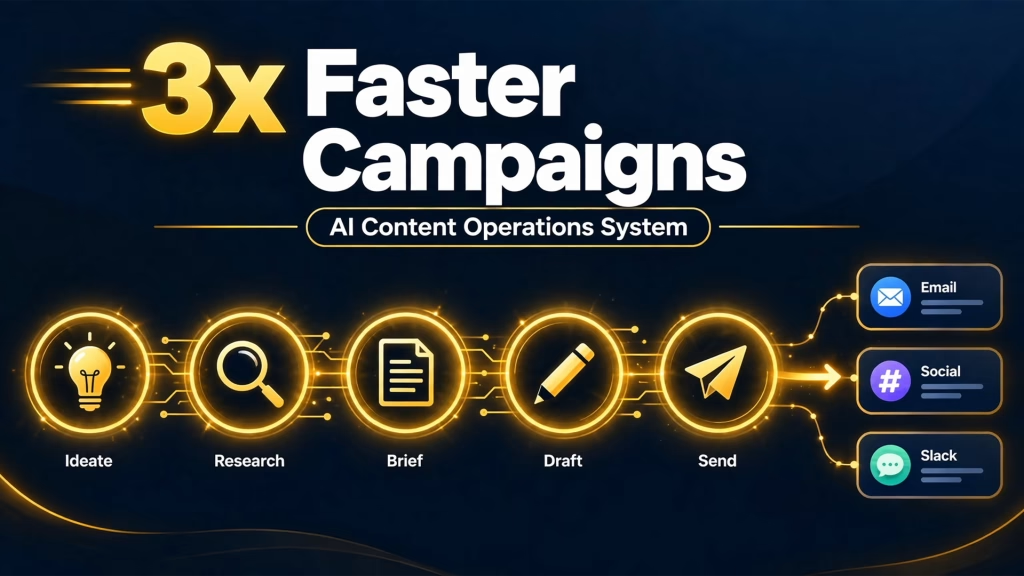
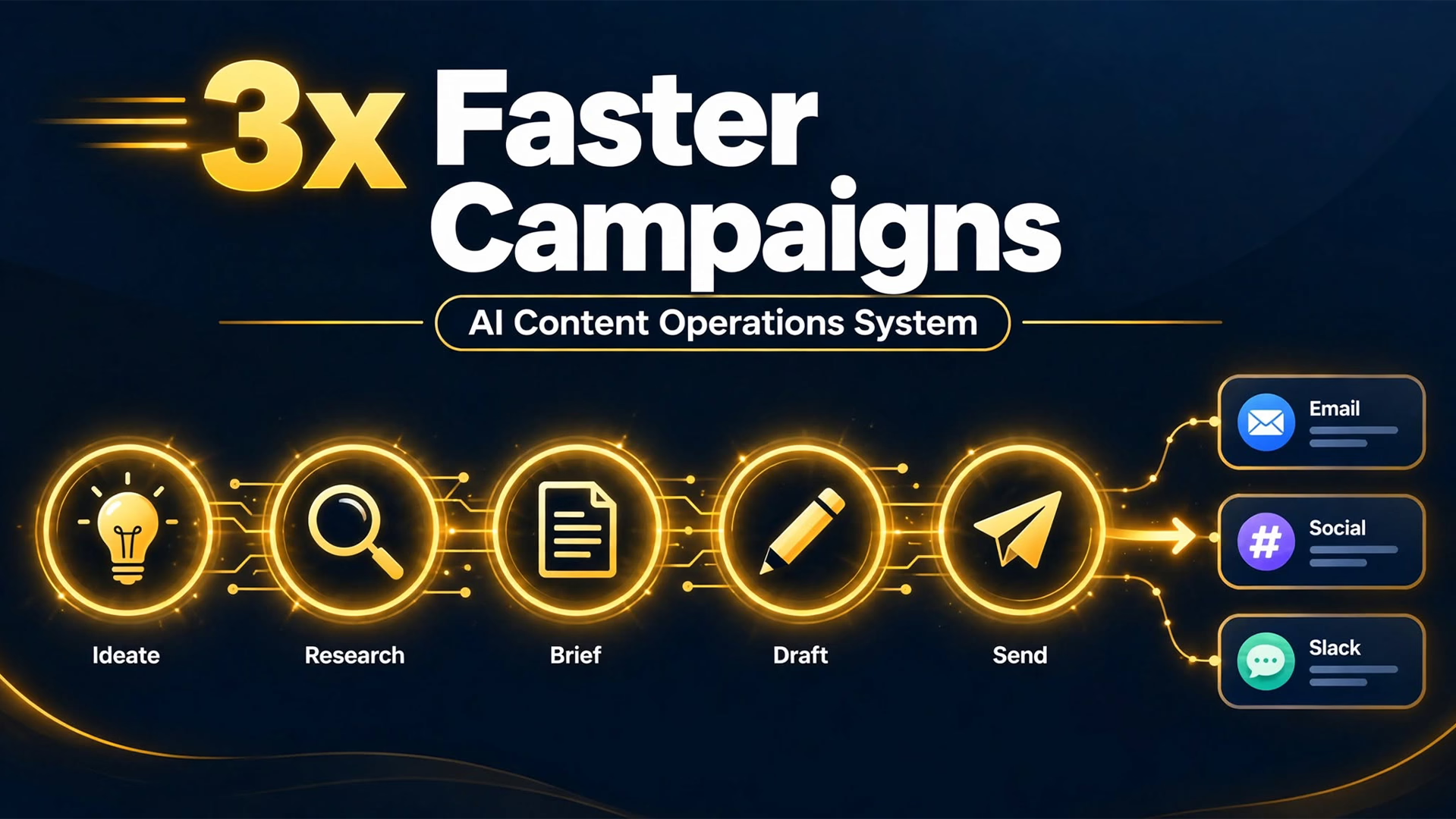
TL;DR: A marketing team’s content production had become a bottleneck. I built an AI content operations system that structures the whole workflow: it generates scored content ideas, assembles sourced research packs, produces standardized briefs, assists with drafting and quality checks, and prepares each piece for multi-channel publishing. Idea-to-ready time fell from about 9 days to 3, research time per piece dropped by roughly 75%, and content quality became more consistent across writers.
An AI content operations system is a structured workflow that uses AI to support every stage of content production, from planning to publishing preparation, while people keep control of strategy and final decisions. In this case study, I explain the problem, how I designed the system, and how a similar setup could speed up your marketing team.
Project snapshot
| Category | Content automation |
| Industry | Marketing |
| My role | Sole consultant: process design, workflow build, prompt design, testing, training, handover |
| Timeline | 5 weeks |
| Stack | Claude, Python, workflow automation |
| Deliverable | Structured AI workflow for planning and production assistance |
| Designed outcome | Faster campaign execution and more consistent content workflows |
The business problem: content production bottlenecks limited marketing velocity
The team had plenty of ideas and plenty of demand, but production could not keep up:
- Ideation was ad hoc. Ideas came from scattered conversations, and no one could easily tell which ones were worth pursuing.
- Research was slow. Writers spent about 2.5 hours per piece gathering sources and facts before writing a word.
- Briefs varied wildly. Each writer and editor worked from a different format, which caused rework and confusion.
- Review cycles dragged. Pieces averaged more than three revision rounds, mostly for voice, structure, and missing details.
- Publishing prep was manual. Metadata, channel versions, links, and checklists were rebuilt for every piece.
The result was slow campaigns, inconsistent quality, and a team that was always busy but rarely ahead.
Goals and constraints
Goals:
- Move from idea to publish-ready faster
- Standardize briefs, quality checks, and publishing prep
- Free writers and editors to focus on strategy and craft
Constraints:
- A human had to approve ideas, research, and final content
- Facts had to be traceable to real sources
- The system had to fit the team’s existing tools and habits
My approach: a structured workflow with AI at every stage and humans at every gate
I designed the AI content operations system as five connected stages. Python orchestrates the steps and stores everything in one structured record per piece, and Claude handles the language and analysis work.
Stage 1: Ideation and prioritization
The system takes inputs such as target audience, keyword themes, past content performance, and campaign goals. Claude generates a backlog of ideas, each with an angle, search intent, funnel stage, and a priority score based on fit with goals. The team approves which ideas move forward.
Stage 2: Research assistance
For each approved idea, Python gathers source material from specified sites and documents. Claude summarizes it and builds a research pack with key facts, statistics, and quotes, each linked to its source. A writer verifies the pack before it moves on, which keeps unsupported claims out of the draft.
Stage 3: Brief generation
Claude assembles a standard brief from the idea and research: goal, audience, primary keyword, outline, key points, required sources, voice rules, and call to action. Every writer now starts from the same structure.
Stage 4: Production assistance and quality checks
Writers use the brief to draft with AI help for outlines, section drafts, and rewrites. Before review, a quality check compares the draft to the brief and brand voice guide, flags missing sections, unsupported claims, and tone drift, and gives the editor a short checklist.
Stage 5: Publishing preparation
Once approved, the system prepares the piece for release: SEO title and meta description, alt text, tracked links, channel-specific versions, and a calendar entry with a completed checklist. For distribution, the finished piece can feed a repurposing workflow like the one in my Content Repurposing Pipeline case study.
Step-by-step build
- Map the current process by interviewing writers and editors and recording where time and quality were lost.
- Design the standard brief and quality checklist with the content lead.
- Build the idea backlog and scoring using audience, keyword, and performance inputs.
- Create the research pack workflow with source collection, summarization, and citation links.
- Build the drafting assistance, quality check, and publishing prep steps with approval gates between stages.
- Pilot with three writers for two weeks, collect feedback, refine the prompts and templates, and roll out to the team.
Tech stack
- Claude: ideation, summarization, brief generation, drafting support, and quality checks
- Python: orchestration, source collection, structured records, and validation
- Workflow automation: triggers, notifications, and approval handoffs between stages
- Structured content record: one place that holds the idea, research, brief, draft status, and publishing details for each piece
Results
| Metric | Before | After |
|---|---|---|
| Idea to publish-ready time | 9 days | 3 days (3x faster) |
| Research time per piece | 2.5 hours | 40 minutes |
| Brief creation time | 90 minutes | 15 minutes |
| Revision rounds per piece | 3.2 | 1.6 |
| First drafts accepted with minor edits | 52% | 80% |
| Content pieces published per month | 24 | 48 |
The team doubled output without adding people, and the content became more consistent because everyone worked from the same structure.
Challenges and what I would improve
Challenge 1: Generic ideas. Early idea lists were broad and repetitive. I fixed this by feeding in past performance data, audience details, and exclusion rules, and by asking for a specific angle for each idea.
Challenge 2: Unverified facts. Some research summaries included details that were hard to trace. I required a source link for every fact and added a human verification step before briefs were created.
Challenge 3: Adoption. Writers worried the system would replace their judgment. I involved them in designing the brief and checklist and kept every creative and approval decision with the team.
Next improvement: connect published content performance back into the idea scoring, so the system learns which topics and formats deliver results.
Key takeaways
- Standardizing the process matters as much as the AI. A shared brief and checklist remove most rework.
- AI works best as production assistance with human approval at each gate.
- Source-linked research is what makes AI-assisted content safe to publish.
Frequently asked questions
What is an AI content operations system?
It is a structured workflow that uses AI to support content ideation, research, briefing, drafting, quality checks, and publishing preparation, with people approving each stage.
Does the AI write all the content?
No. It assists with planning, research, and drafting, while writers and editors own the strategy, voice, and final approval.
How is this different from a content repurposing pipeline?
An AI content operations system covers creating content from idea to publish-ready. A repurposing pipeline takes finished content and adapts it for other channels. They work well together.
How long does it take to build an AI content operations system?
For a focused marketing team setup like this one, about five weeks from process mapping to rollout.
Want an AI content operations system for your marketing team?
- Business owners and marketing leaders: Book a 20-minute workflow audit and I will show where your content process loses the most time.
- Recruiters and hiring teams: View my resume or contact me about remote AI automation and marketing operations roles.
