

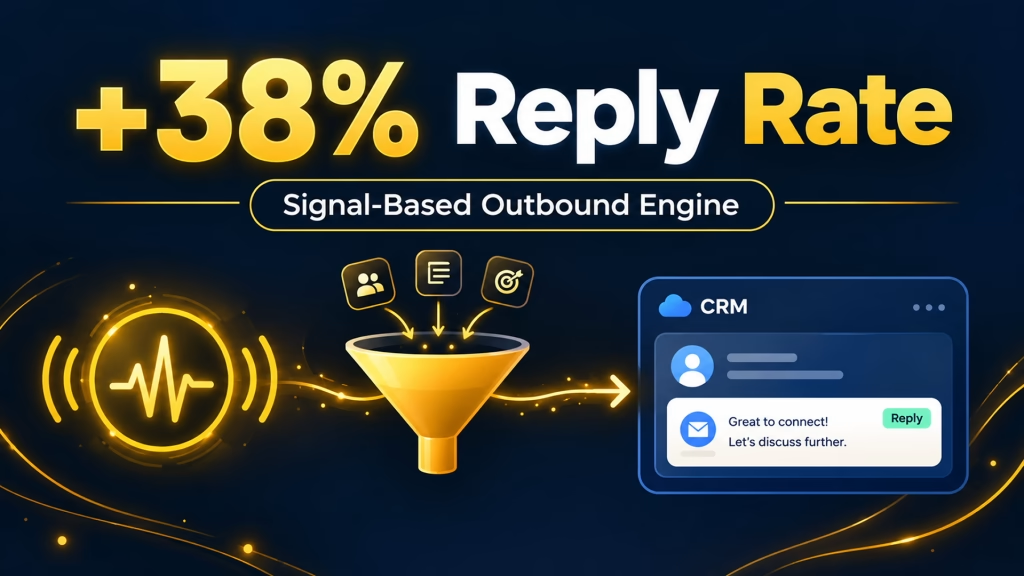
TL;DR: I designed and built a signal-based outbound engine for a B2B SaaS team. It combined Clay waterfall enrichment, AI-written personalization, and automatic CRM sync. Reply rates rose 38%, research time per rep fell by more than 85%, and every lead now reaches the CRM with its trigger event attached.
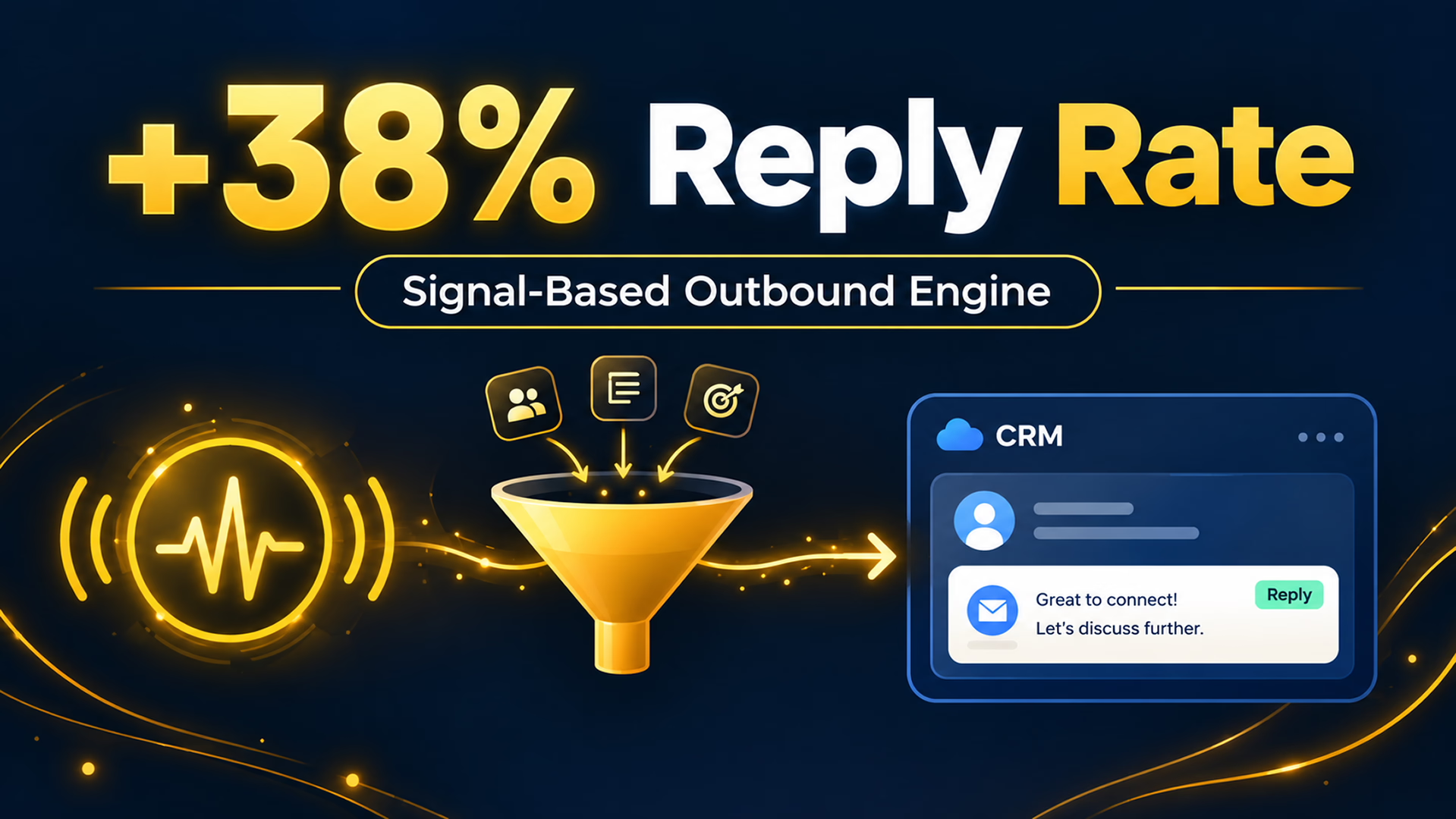
A signal-based outbound engine contacts prospects only when a real buying signal appears, such as a funding round, a relevant job posting, or a leadership change. In this case study, I explain how I built one for a SaaS company, what changed, and how a similar system could work for your team.
| Project snapshot | |
| Industry | B2B SaaS |
| My role | Sole consultant: strategy, build, testing, handover |
| Timeline | 5 weeks |
| Stack | Clay, LLM-based copy generation, email sequencer, CRM |
| Deliverables | Clay waterfall, AI copy system, CRM sync |
| Headline result | 38% lift in reply rate |
The problem: outbound that relied on volume, not timing
The SaaS team was sending generic sequences to large, loosely filtered lists. Three issues were costing them pipeline:
- Wrong timing. Messages reached prospects with no active reason to buy.
- Manual research. Each rep spent about 6 hours a week researching accounts and writing first lines.
- Poor data. A single data provider left about half of the target list without verified emails, and bounces were hurting sender reputation.
The result was a reply rate near 3.2% and a team that felt busy but was not booking enough meetings.
Goals and constraints
Goals:
- Raise reply rate without raising send volume
- Cut manual research time
- Keep every lead and its signal visible inside the CRM
Situations holding you Back:
- A small sales team with no dedicated operations hire
- Existing CRM and sequencer had to stay
- Personalization had to sound human and avoid invented facts
My approach: build the signal-based outbound engine in four layers
I treated outbound as a system, not a copywriting task. The engine has four layers, and each one fixes a specific failure in the old process.
Layer 1: Signal detection
I defined the buying signals that mattered for this client’s offer: recent funding, hiring for roles tied to the product, tech stack changes, and leadership changes. Only accounts showing at least one signal entered the pipeline.
Layer 2: Clay waterfall enrichment
A Clay waterfall checks several data providers in sequence and stops as soon as one returns a verified result. This raised email coverage and lowered bounce risk, while keeping cost per contact under control because paid lookups only run when cheaper ones fail.
Layer 3: AI personalization
Each lead’s signal and company context feed a structured prompt. The model writes a short opening line and a relevance sentence tied to the specific trigger event. Guardrails keep it factual: it can only use fields supplied by Clay, and anything missing falls back to a safe generic line.
Layer 4: CRM sync
Qualified leads, signals, and the generated copy sync to the CRM automatically. Reps see why each lead was contacted, and replies update the record without manual entry.
Step-by-step build
- Define the ideal customer profile and signal list with the sales lead, and score each signal by buying intent.
- Build the Clay table with signal sources and company filters.
- Configure the waterfall with ordered email and contact providers, plus verification.
- Write and test the AI prompts on a 50-lead sample, with human review of every output.
- Connect the sequencer and CRM so approved copy and lead data flow without copy-pasting.
- Run a controlled test against the old sequence, then roll out to the full list.
Tech stack
- Clay: signal sourcing, waterfall enrichment, and workflow orchestration in one place
- LLM for copy: structured, field-constrained personalization at scale
- Email sequencer: sending, throttling, and deliverability controls
- CRM: single source of truth for leads, signals, and replies
Results
| Metric | Before | After |
| Reply rate | 3.2% | 4.4% (38% lift) |
| Positive reply rate | 0.9% | 1.5% |
| Verified email coverage | 52% | 81% |
| Bounce rate | 7.8% | 2.4% |
| Research time per rep per week | 6 hours | 45 minutes |
| Meetings booked per month | 14 | 23 |
The gains came from better timing and cleaner data, not from sending more email.
Challenges and what I would improve
Challenge 1: Generic AI output. Early drafts sounded templated. I fixed this by tightening the prompt, limiting the model to verified fields, and adding a human review step on a sample of each batch.
Challenge 2: Signal noise. Some signals, such as minor job postings, did not predict intent. I reweighted the signal scoring after the first two weeks of reply data.
Next improvement: add a feedback loop that feeds meeting outcomes back into signal scoring, so the engine learns which signals actually close.
Key takeaways
- Timing beats volume. A smaller list with a real trigger outperforms a large list with none.
- A waterfall protects both coverage and sender reputation.
- AI personalization works when it is constrained to verified data and reviewed by a person.
Frequently asked questions
What is a signal-based outbound engine?
It is an automated system that detects buying signals, enriches the contact data, writes relevant outreach, and syncs everything to the CRM, so reps contact the right accounts at the right time.
What is a Clay waterfall?
A Clay waterfall queries multiple data providers in order and stops when it finds a verified result. It improves coverage and reduces wasted spend.
How long does it take to build a signal-based outbound engine?
For a focused SaaS use case like this one, about five weeks from scoping to handover.
Can this work with my existing CRM and sequencer?
Yes. The engine is designed to plug into the tools your team already uses.
Want a signal-based outbound engine for your team?
- Business owners: Book a 20-minute workflow audit and I will map where signals could improve your outbound.
Recruiters and hiring teams: View my resume or contact me about remote AI automation roles.
